Synopsis
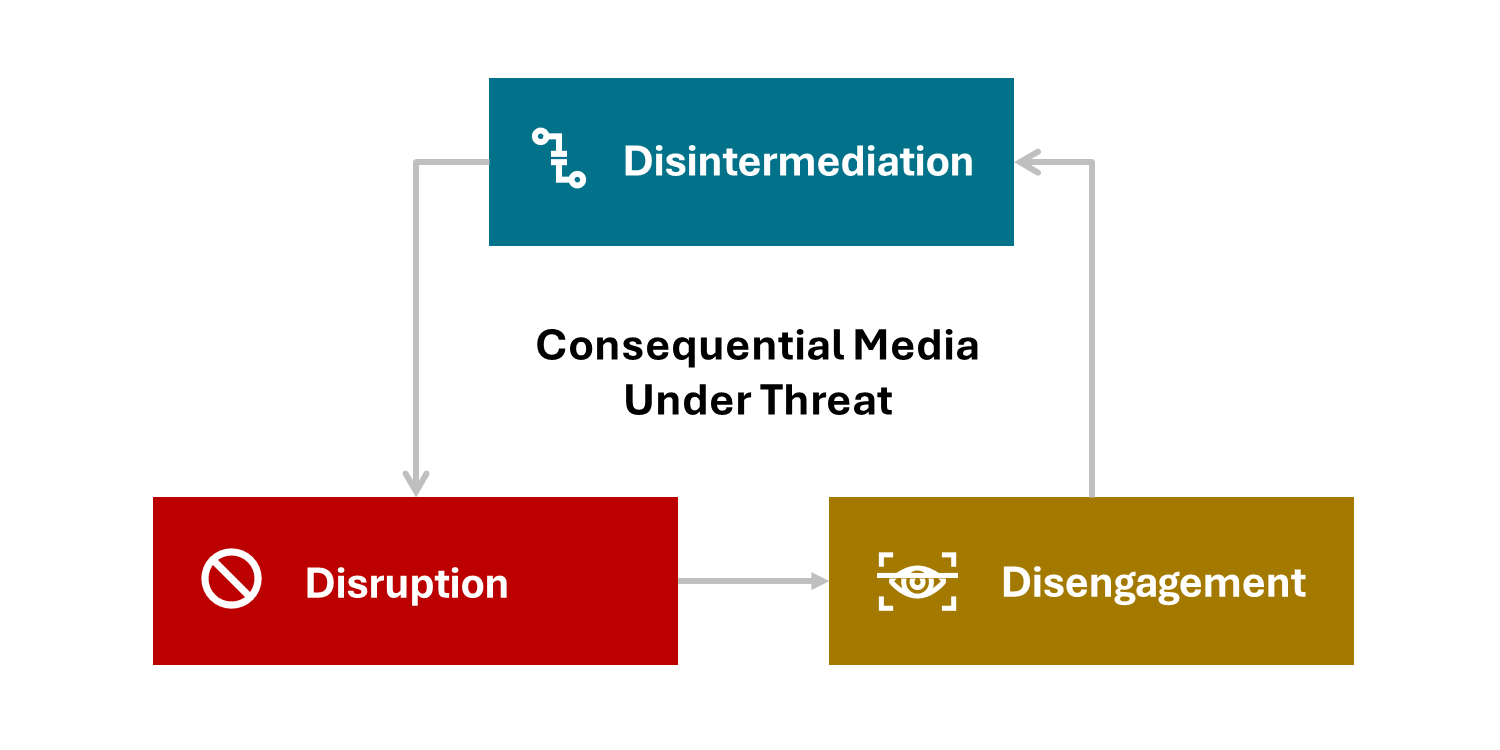
News media are disappearing at the very moment society needs them most. Across the world, local and investigative journalism is being hollowed out by three converging forces:
- Disintermediation by Big Tech
- Disruption by increasingly authoritarian power, and
- Disengagement by audiences and advertisers.
The result is not just an industry in crisis, but a growing inability for people to form well-founded beliefs, opinions, survival strategies and action plans in an age of profound uncertainty.
Our white paper, Understanding the News Media Crisis: Three Threats to Consequential Media, examines these forces in depth and suggests that, amid increasing polarisation globally, many current attempts to “save journalism” are too narrow, too politicised, and too focused on supply-side definitions of what news ought to be. The paper proposes a broad, ideologically neutral concept — Consequential Media — encompassing any source people genuinely rely on for current information that shapes how they understand and act in the world. This definition can bring more individuals and organisations back to news.
The paper concludes that decentralised strategies and technologies are essential to resolving the core contradiction of our time: a pluralistic information ecosystem trapped inside an increasingly centralised attention economy.
Why this matters now
The decline of news media is often discussed as an industry problem. This paper treats it as a systems problem.
When original, accountable sources disappear, the vacuum is filled by derivative, unaccountable and increasingly synthetic information. Without intervention, the next decade risks producing a world that is more informed in volume but less informed in consequence.
As Nobel Peace Prize laureate Maria Ressa has warned, the window for securing new models of media sustainability may be measured in years – not decades.
Who this is for
- News and media leaders grappling with sustainability
- Institutional media investors
- Media catalyst organisations
- Technology and platform strategists
- Researchers and journalists
- Policymakers concerned with democratic resilience
- Anyone worried about what replaces journalism if it collapses
About the author
Jason Lambert (Copenhagen, Denmark) is a senior executive and leader at the intersection of news media business performance and technology. Jason has managed the Digital division of the UK and Ireland’s national news agency; created an online advertising representation business for news media; and consulted with news media in more than 40 countries in digital and strategy development; and run a financial services agency specialised in driving traders to forex, stock, and derivatives brokerages.
Jason co-founded a specialist consulting brand in 2017, acquired by Internews in 2020, with Jason then leading its global practice focused on the financial sustainability of independent media. This included leadership of Internews’ United for News coalition, launched in partnership with the World Economic Forum, and creating its Ads for News initiative that brought new programmatic advertising revenue to hundreds of independent media worldwide.
Jason’s paper, Simplifying Success, which proposed a global data platform and framework for better understanding how independent media could compete for audiences and revenue, led to the $16 million Media Viability Accelerator (“MVA”), funded by USAID and Microsoft. Jason was then MVA’s Head of Product until it was cancelled amid the US restructuring of foreign aid in early 2025.
Jason holds an Executive MBA and master’s in management of technology from the Technical University of Denmark (DTU), is founder of Felixe and a board member of Levelflow Foundation.
Understanding the News Media Crisis: Three Threats to Consequential Media